I took some photos today of the process of teaching a horse not to "mug" for treats. This is Stowaway, a lesson pony who is the least clicker savvy of my horses. He has been here for the shortest amount of time and is a pretty solid lesson pony who hasn't needed a lot of work on his behavior. I hesitated to do too much clicker training with him because I didn't want to get into something with him that the kids couldn't follow through on. But I do occasionally let them give him a treat- for instance I like to click and treat the lesson ponies when they take the bit. The little students tend to get the bit up the ponies nose, down inside their lip or anywhere but between the teeth. Added to that is the hand in the eyeball, ears being squashed, etc and I feel like any pony who tolerates that deserves a reward!!! So I click but that can cause a problem when the ponies then reach for me while the kids are still trying to squash those ears around so I now have the kids themselves feed the treat.
So- the ponies need to stand and wait for the treat to be delivered, not go after those little fingers looking for their deserved reward.
 This first photo is a typical mugging pony. He has reached around in front of me and is headed for my hand, his ears showing his intent. Through all these photos, the lead is either dangling or thrown over his neck. I am not using the lead at all to influence his behavior. I have a body position for myself which acts as a "cue" (see the other posts about cues) to remind a pony how to behave when he smells treats. I stand next to the pony's head, facing forward and with my hands crossed at my waist. All the other horses have learned that when I stand like that, it is their job to stand quietly at my side...the "no mugging" pose leads into the "grownups are talking" exercise. If you have a horse who is actually biting hands or is otherwise being dangerous, this exercise should be started with the horse in a stall with a dutch door or stall guard so that the horse cannot actually reach you. But Stowaway just needed a little reminder lesson. So when he reached like this, I simply stood still, looked forward and only looked at him out of the corner of my eye.
  This next photo shows the tiny baby step I was looking for as an improvement over the previous. I was not looking for him to do any more than turn his head away from me slightly. Comparing the photos, you can see the difference. With that tiny movement away from me, I clicked/treated. A movement is easier for a horse to figure out than a duration exercise anyway. So as far as Stowaway was concerned, I had clicked for him turning his head away. He is familiar enough with clicking to understand that and after I gave him his treat, he chewed it while keeping his head out of my space. It is also very important to follow the rules of good feeding. I was careful to feed him away from my body: after I clicked, I turn toward him and extend my hand toward his chest so that he is always have to rock back from me to actually receive the treat...if the treat is always found under his neck, there is less incentive to reach toward the handler for it.
  So here in this third photo, he is still flexed slightly toward me, but certainly not what I would call in my space. He is chewing his treat and waiting so I quickly click again to reward him for not reaching toward me again. Sometimes in an exercise like this it is helpful to click in fairly rapid succession so they get lots of rewards for being out of your space and aren't tempted to reach since the treats are coming regularly without that. Then you can gradually lengthen the time between clicks- 1 second, 2 seconds, 3 seconds, etc. This is where you transition to the Grownups are Talking exercise. Not only is he not allowed to mug, he is expected to stand quietly next to me and just wait patiently.
And that leads us to the final photo: Here, Stowaway is standing quietly and just waiting for the C/T. I can count up to 10, 15, 20, etc as I lengthen this out and what he has learned is that the C/T only comes when he is waiting like this, never when he is in my space and if he waits long enough, he will be reinforced for it. Most of the horses go through a stage where they actually turn their heads away from the handler, which comes from that initial moving the head away being reinforced. You can let this happen, time your click carefully so that you click when the head is straight forward, or wait until the head comes back to a center position to click.
Stowaway gets bonus points for standing there (he was allowed to graze) while I ran back and forth to the camera to set it on 10 second delay and then ran back to him!! :)
 It doesn't matter if they are human or equine, the similarities are uncanny. The 3 yr old has times when he just tunes me out and wants to go play his own games and it doesn't seem like I can do anything to please him. The 2 yr old doesn't mind her bath now but she wants to do it By Herself. She wants me to stand there and tell her how brilliant she is but she'd rather wave the sponge and scraper around on her own and if I get a little too pushy with the cleaning bit (isn't that the POINT of a bath?) she jumps out of the tub and runs around the bathroom until I hand the sponge back to her. And she drinks the bath water. The one year old wants to be the center of attention and/or be where everybody else is. If he's inside, he wants to be outside, if he's outside, he wants to be inside. When I'm playing with the 3 year old he hangs over the fence and calls for my attention. When I'm giving the 2 year old a bath, he's swinging on the bathroom door and banging things around so I'll pay attention to him.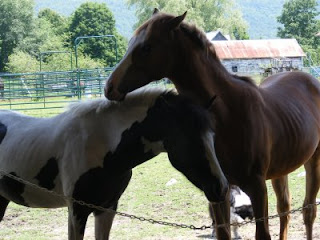
And yes, then the phone rings. Expecting an important call, I extract the phone from my pocket with a soggy hand covered in hay stretcher pellet crumbs. The first call is my husband who understands my predicament. The second call is the Important one and I have to juggle sponge (which I have taken away from the 2 yr old as she was winging water at me with it) and phone while fending off the toddlers who are leaning on the chain across the door, trying to bust through to get at me and all that fun stuff.
By the time I'm done with all 3 of them, I need a tall glass of iced tea and hammock. At least I can do the first.
For anyone not familiar with +P, it stands for Positive Punishment. It's one of the four quadrants of operant conditioning (the others being +R, -R, -P). In my quest to be a Good Clicker Trainer, I try to use +R (positive reinforcement) as much as possible. I try to ignore the bad behavior and just reinforce the good. But this is sort of a confessional blog post in which I have to admit to using +P and I'm not totally sure how I could have avoided it.
The subject is Ande- 3 yrs old and quite a good egg all in all. He's sensible, well-behaved, and cute. As with all the CT horses, he loves attention. The past many months I have seen one naughty behavior creep into his repertoire and looking back, I can see I have been allowing him to reinforce this behavior (+R) for a long time when I thought I was simply ignoring the behavior. Tricky stuff, this.
I have been told by several people that QH's will sometimes just bolt off. It is fascinating to watch Ande play compared to the others. When he's feeling rowdy, he will go from a standstill to a tearing gallop in a straight line as far and fast as he can, and then slam on the brakes to do a sliding stop. He'll sometimes throw in a buck but he seems to love to go fast and straight and stop. Anybody want a cool little Gymkhana pony? Games? So I shouldn't be surprised that he has occasionally gotten it in his head while being led and feeling good, that he'd decide to just leave town. When he did that as a yearling or 2 yr old, I usually just let him go- oops. Usually I had another horse in the other hand (like the younger Rumer who I was focusing on) and we were just going out to pasture so it was easier to just let him go on his own than get in a big battle. I thought I was "ignoring the bad" behavior. Instead, the fun of tearing off and the grass were reinforcers for his behavior. I did do a LOT of +R work with him in hand. He definitely knows the correct way to walk quietly at my side, slack in the lead, yielding his shoulders if asked, giving to pressure on the lead for a flexion, etc. This spring he bolted from me twice and I tried to stop him by holding the lead- hoping all the in-hand work and hip gives would swing him around me to stop. But no. But I guess when he is feeling three-ish, the gallop is a stronger reinforcer than the attention and the CT.
A week or so ago, I started taking him out to the arena to get him used to working out there, as opposed to just the round pen. The arena is a bit of a walk from the barn, through a scary barnyard (one never knows what sort of farm equipment will be lurking there) and completely out of sight of the horse barns, paddocks and other horses. He has been out there before- last summer I used to turn him out there with Rumer to help eat down the grass. Now, however, there is sand in that arena and I was taking him out ALONE. He had come to the barnyard and driveway in the winter and been great. But I sensed this day that he was feeling a little like whoopee! So rather than ask him to do any work out there, I simply let him go so he could play. He put on a very impressive gallop from a standstill, fly down to the far end, almost sit down as his slid in the sand to a stop, whirl and do it again. When he did stop, he would raise his head toward the horse barn and hear Rumer calling him (silly filly isn't even turned out with him any more- why did she need to do that??). I let him burn off steam until he was heaving and then took him back. The next day I did it again and this time, he did it for less time and then stopped to graze a bit along the edge where he could reach good grass under the fence. But he would still listen and look for the others. But the part that had me concerned was that I could tell I did not have his attention on the way to the arena and back. I was concerned about a bolting incident while I was leading him and did not want him to be reinforced for this any more.
So I did something probably most clicker trainers would have me shot for and I put a chain over his nose the next time I took him out. I jiggled it a couple times on the way out just so he knew it was there but he did not try anything. Once in the arena, I swapped the lead for a longe line- but left the chain on. Sure enough, when I let him out on the line, he took off in a straight line away from me, so I braced myself and let him hit the chain. He was quite astonished and for the first time, actually stopped from a bolt. But he had been reinforced many times when he got away from me, so he had to try it many more times. Each time I was careful not to instigate it. I was simply asking him to longe as we have been doing in the round pen- I C/T'd when he did nice transitions or was moving well, but I would occasionally see his attention waver and I'd prepare myself just in time for him to take off so I could "be a tree" and let him hit the end of the line on his own. I think it was a legitimate +P. It was immediate, it was harsh enough to make an impression and it was over quickly- I did not follow up with yanking or yelling or chasing. I just asked him to move off again and went back to CT.
The next day I confess my right arm was a bit sore from almost being yanked out of the socket so I longed him in the round pen- hopefully a reminder to him that it could all be quiet and nice. Then the day after that we went back to the arena. He tried bolting a couple times but nothing like before- seemed to be testing to see if the rules were the same, but I also tried to mentallly be very friendly to encourage him to work with me. I wanted him to really find that it was far more enjoyable to work with me but when he "left", that nasty chain (totally apart from me) was going to get his poor little nose.
My next trial I think will be finding some really yummy treats, and find a game- maybe a new one, that he really likes to do in the arena. I want him to look forward to going out there with me and anticipate fun. I want to be careful that these couple lessons don't make him dread the arena. So I guess the best way to have avoided using this rather drastic +P would have been to deal with the undesired behavior at an earlier stage. Neither of the other two babies shows any inclination towards bolting...maybe it's a QH or QP thing, maybe I have done a better job at +R them...I certainly began their CT at a much younger age than Ande (he was a yearling before I introduced the clicker because at that point, I was afraid of using treats with a baby.)
I think I have put a link to Katie Bartlett's site here before, but just in case- she has a fantastic, if long and complex, article on the Four Quadrants which I highly recommend.
I took the cart out again today and both Rumer and Percy were much more inclined to come play than make a big deal out of it. I had to be pretty far away in order to get the whole area on the video so the detail isn't great but here is the basis of what I did:
I began as I did before, just pulling the cart into the paddock and both ponies immediately began following the cart. Rumer remembered that the place to be was next to me so even though I did not slow down, she quickly caught up with me to be alongside the shafts. I clicked and treated her for remembering and being right there. After a couple times, it soon became a little difficult to keep going because I had two ponies right in the way and not at all worried about the cart.
The video is too far to hear the clicks but you can see when I treat and at one point I bump her in several places with the shafts as I did last time and C/T her for standing still. Only once does she startle and pull away but I just ignore that. I also take a little jog around and both are happy to jog along with me, getting used to the noise and bouncing of the cart. Maybe Percy could be driven!! I also put the shafts up a couple times, so they can become accustomed to that.
As usual, my biggest challenge is getting Rumer to stand still so I can do things to her rather than her being the one to be clambering over me. So I brought the plywood mat in. I had no real goal here- just playing and seeing what I could accomplish. I knew it would be a challenge for her to focus on the mat work with the cart right there and Percy wanting to play too. But in fact she was fine with it all and got right on it. A couple time I repositioned her by just having her target my hand.
Percy became much more of a challenge to my focus! I got Rumer lined up on the mat a couple times, with the cart right in place behind her. I was able to leave her and walk back a little ways toward the cart and have her stand.
You can see the video at http://www.youtube.com/user/BookendsPonies
Rumer is continuing to progress with her long lining. Today I put the traces on her for the first time, along with the surcingle and long lines. I left the breeching off- without the cart to attach all the pieces to, there are a lot of straps hanging off here and there, tied up where I can so they don't drag but it's a lot flapping so I'm trying to be careful not to overdo it at any one time. Her ears kept an eye on it for the first 15 feet or so, until I put my hand out to target in front of her and then her attention focused forward. I love having all these horses willing to follow my hand as a target and get mad at myself when I forget to take advantage of it. The babies are way more into it than the older horses...another symptom of the older horses thinking they shouldn't do anything unless "told to", as opposed to the babies who are thrilled to take initiative.
I still had the long lines attached only to her halter and today worked on getting a little further away from her. I started out by beginning to transfer her go forward cue with the rein to a sound cue. As I write this I can't believe how stupid I am. I just realized how much I probably confused her. I was trying to transfer her to a kiss sound for going forward. I watched a video of someone else using that and it's what I used for Ande as well. But this winter, I had heavily reinforced everyone for coming to me with that sound. It's great when someone gets loose, or is out far in a paddock, for me to do that and they react at least by looking at me and sometimes by coming running. So no wonder she kept spinning toward me when I did that to try to get her to move forward. And why did I not figure that out until I was writing this? I'll credit PMS.
I guess I'll just be glad I am writing this as a training log and have figured it out. We'll try again tomorrow and perhaps a "walk on" instead. Even so, she did allow me to get further from her once she was going forward from a rein cue...she just didn't get it when I tried to kiss her forward from a distance. Thank God horses are so forgiving!
 That's the way one of the lesson moms referred to Rumer the other day :) I certainly knew who she meant- Rumer has inherited her mom's abundance of mane and forelock. But I decided it didn't help her look much that I had pulled her mane from the withers forward and stopped about 6 inches short of her poll and never went back to finish it. So she looked like one of those Thelwell ponies who's just had his mane washed.
I have to give a product endorsement here, even though I'm not famous enough to get paid for it: I love the "Solo" pulling comb. There is no "pulling" involved so the horses don't mind it, your fingers don't mind it, and it does a very quick job. It does thin somewhat, although not as good as regular pulling. And with some of these ponies, nothing short of hedge trimmers is really going to be faster. I've done 2 TB manes, one QH mane and two pony manes with the blades that were on it (and I mean from winter, bottom-of-the-neck length) and they still work. I have had to take it apart several times (a 2-second job) when it got bogged down with hair, but then it works great again.
So after finishing Rumer's mane, cutting her first bridle path (I used scissors since my clipper blades need to be sharpened) and trimming the dead ends off her forelock, she looked so much better than I needed to face the bath scene again. By now, the days are warm enough that setting a bucket out in the sun supplies warm water so I emptied a morning water bucket into a wash bucket with sponge and scraper. This provided amusement for both of us for the entire session since drinking water out of a bucket with a sponge was a new and fun experience for her so every few minutes, she'd go over and push the sponge around with her nose, drink a sip, and then be done. But it seemed to provide a little break when she needed it so I just let her do it, even though the water got pretty gross.
Because she has gotten so good about so many things, I decided to sponge her with no clicking. I was curious to see how she would respond. The result was that I did bathe her entire body (didn't try legs) and managed to get her looking better. However, I also got soaked myself; the barn walls and a 12 foot area underfoot got more water than she did; and she never stood still for any of it. She didn't do anything bad or wrong, just kept moving away every time I put the dripping sponge on her. Because she was so quick with her hind legs as a wee one, I watched them carefully to make sure she didn't get defensive with them when I sponged her rump. I've seen many an older horse get a bath this way on a regular basis. But it wasn't really what I was looking for. So I scraped her off (one of her biggest issues was the drippy water running all over her tickling like a herd of flies) and decided to start again.
I got out the doormat I used to use for mat work. The plywood was out in the round pen and this was easier to grab, plus I thought it would be less slippery when wet. I have done little mat work with Rumer- not much more than getting her used to stepping on it. And this was a different type mat so I just started from the beginning. One of the most frustrating things about the doormat is when they paw at it, it flops all over the place. That is good for getting them used to things under their feet, but is a pain to try to hold it in place with your toe so that it stays put until they stop pawing. But we muddled through until she got the point that standing with both front feet on it was rewarded and none of the other nonsense was. I could step away from her and count to about 5 without her moving so I pulled out the sponge again. At first I literally just pulled the sponge up out of the water a little and C/T'd her for not moving. I was going to have to overcome all her moving behavior from earlier. My goal was to have her stay on that mat.
I worked very slowly up to pulling the sponge out, wringing it out and wiping her with it. Once I was using the sponge, it was getting complicated with the sponge, the treats and the rope, so since my goal was to have her stand, I just unclipped the rope and she was free to go or stay. She did a little experimentation with stepping off and on again, but found that standing still got a more regular reinforcement rate than stepping off and on again. Of course she still had to step off occasionally and play her little Bob-for-Sponges game, but then she'd go back onto the mat. Once I could wipe her neck and shoulders with the damp sponge and have her not move from her mat while I went back and forth to the bucket, I decided that was enough for that day. Between the water, the treats and the sand from the mat, I too, looked like a Thelwell model...
Moral of the story is- she capable of handling "normal" training (ie she's not difficult or been spoiled by CT as some would predict) but I'll have a much more cooperative and happy pony if I continue with the CT method!
Since Rumer has gotten comfortable with all the parts of the harness, it's high time I started long lining her in preparation for driving. I decided that rather than putting a bit in her mouth as a start, I would begin with a halter and see if we can learn to steer without the fuss of all the initial bit chewing, etc.
I was intentionally a little careless when I put the surcingle on her so that she gets more comfortable with all those long straps accidentally flapping around her legs. It still amazes me when I work with her at how laid back she has become compared to what she was as a foal and yearling! I only put the surcingle on this time since we are introducing something new; I wanted to keep it simple. Then, rather than use long reins at the start, I simply clipped a long lead rope to each side of her halter and ran each one back through the rings on the surcingle.
Keeping it as absolutely simple as possible, I started by standing right next to her, putting very light pressure on the left rope near her halter and clicking and treating the second she responded by turning her head just a hair to the left. I repeated this several times until I could get a full head turn left with just a touch on the rope.
Then I did the same with the right rope, but I stayed on the left side. This is often a confusing part for young ones, since they are turning away from the handler and it goes against most of what they've experienced in their short lives. That's another good reason to teach cross tying by having the ties just looped through rings so you can pull them back and forth...that is their first experience with "counter bending" if you will and can be done at a very young age. Rumer took a moment but once she had been C/Td for that first tentative turn away from me, she was more than willing to repeat to whatever grade of bend I asked for.
The other thing that is important to note and break down here is the difference between lead pressure out from the halter vs lead pressure back. When being led, I put pressure on the lead to ask her to come with me (or on the cross ties) by pulling toward me. But once those ropes were through the rings on the surcingle, the pressure was pulling back, not out. So I had to acknowledge this was something new for her and be sure to understand any confusion or hesitation that might have shown up. I am hoping that this is also being made simpler for her by using ropes, rather than a bit and rein at first. By the time I ask her to do this with a bit in her mouth, she will understand that pressure back also means yield to the side, not stop or anything else.
The next step was to ask her to go forward since she was still standing in the aisle. I made sure both ropes had plenty of slack in them and slid down the left rope and put a little pressure forward on it when I reached the ring of her halter. She hesitated a moment but took a somewhat resistant half-step forward so I immediately released the rope and C/T'd. The beauty of clicker training is always apparent when starting new things. She was immediately engaged in the learning, had already figured out what the right answer was, and we could move right on to fine tuning. That isn't to say that I started asking for a lot more out of her right off, just that there was no resistance, concern, "laziness" or reluctance to head off out into the paddock each time I slid down the rein. I did have to be careful with my food delivery- she is 100% pony and if I cheat and feed her just a little closer to my body, she will meet me right there or closer the next time! She can also be like her mom (Kizzy) and get very excited about the food, so I move slowly but methodically so that the food delivery is consistent and reliable and she can respond in the same way.
So we had several trials of her just moving off from the rope cue, with me keeping in mind that doing all this with the surcingle on was asking more that having her just walk around with the surcingle. It looked to me as if she had forgotten completely about the surcingle- her attention was focused on the job and ears were either relaxed to the sides or on me- not flicking back to wonder about all that leather stuff. I was also careful not to click if her ears looked at all cranky- I am intent on avoiding ear pinning and don't want to click any time ears are back for any reason. That is NOT something I want to reinforce.
I then varied between stopping and asking her to yield her nose to the rope cues a couple times in each direction with a C/T for each one; then we stepped off and went anywhere from 2 to 10 steps before I clicked her for a steady tempo, head and neck straight and ears relaxed. I stayed on the left side for this whole lesson, but I did ask her to turn in a large circle to the right toward the end. We used the whole area of the paddock for this circle. I wasn't asking for an extreme turn away from me, just the idea that she could follow the rope cue away from my body.
 This first photo is a typical mugging pony. He has reached around in front of me and is headed for my hand, his ears showing his intent. Through all these photos, the lead is either dangling or thrown over his neck. I am not using the lead at all to influence his behavior. I have a body position for myself which acts as a "cue" (see the other posts about cues) to remind a pony how to behave when he smells treats. I stand next to the pony's head, facing forward and with my hands crossed at my waist. All the other horses have learned that when I stand like that, it is their job to stand quietly at my side...the "no mugging" pose leads into the "grownups are talking" exercise. If you have a horse who is actually biting hands or is otherwise being dangerous, this exercise should be started with the horse in a stall with a dutch door or stall guard so that the horse cannot actually reach you. But Stowaway just needed a little reminder lesson. So when he reached like this, I simply stood still, looked forward and only looked at him out of the corner of my eye.
 So here in this third photo, he is still flexed slightly toward me, but certainly not what I would call in my space. He is chewing his treat and waiting so I quickly click again to reward him for not reaching toward me again. Sometimes in an exercise like this it is helpful to click in fairly rapid succession so they get lots of rewards for being out of your space and aren't tempted to reach since the treats are coming regularly without that. Then you can gradually lengthen the time between clicks- 1 second, 2 seconds, 3 seconds, etc. This is where you transition to the Grownups are Talking exercise. Not only is he not allowed to mug, he is expected to stand quietly next to me and just wait patiently.
 Here, Stowaway is standing quietly and just waiting for the C/T. I can count up to 10, 15, 20, etc as I lengthen this out and what he has learned is that the C/T only comes when he is waiting like this, never when he is in my space and if he waits long enough, he will be reinforced for it. Most of the horses go through a stage where they actually turn their heads away from the handler, which comes from that initial moving the head away being reinforced. You can let this happen, time your click carefully so that you click when the head is straight forward, or wait until the head comes back to a center position to click.


