Wednesday, January 8, 2020

Training Motivation in a Wintry World

I'll be the first to admit that I get into a training funk in the fall.  Not the early fall.  That is a glorious time to be alive, be outside, and sharing time with horses. They agree. It's when the damp cold sets in that I find myself wanting to get back inside after chores, rather than spending more time cold.  The leaves are off the trees and it's what's known as "stick season" around here. The trees are bare and everything is a shade of brown, black and gray. Yuck. Holiday season is approaching and then here and I find myself avoiding training. 

But after Christmas, I give myself a stern talking to and know I can't let the whole winter go by like this. Everything is now bright white with snow, the air is colder but drier and we have all acclimated to the winter temperatures. The easiest way to motivate myself into the cold outdoors on a daily basis is with training plans. But first I have to make the plans. This year I even had trouble doing that. After putting it off another week, I finally decided I'd just look at January of last year and follow that.  Once I opened my journal to look back, I was reminded of all the things we'd worked on and the progress we'd made.  From there it was easy to adapt last year's January plans to new ones for this year. And I was really excited to see the horses pick right up where we left off, even though I was prepared to backtrack if necessary after some weeks off. 

In the winter, I plan for really short sessions. Most days it's only 5-10 minutes. That protects hands from freezing. But as a friend used to say, "ten minutes is better than no minutes". That friend is no longer on this earth, but I think of her fondly every time I say it to myself. In better weather, ten minutes often extends to longer. But this time of year, it's plenty. 

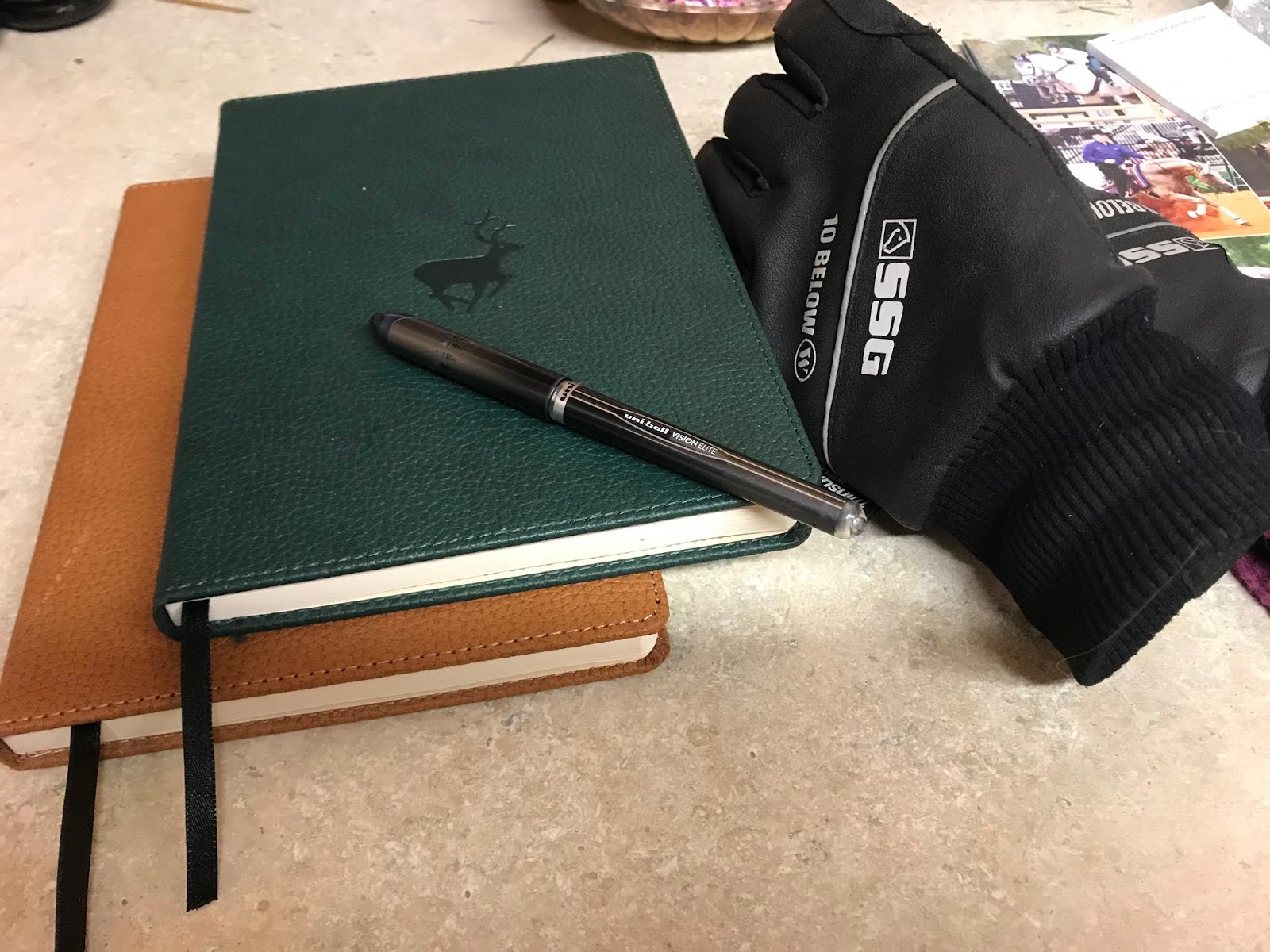
In the winter especially, I also develop rotations of training days. I pick five to seven different things to work on and assign them Day 1, Day 2, Day 3, etc.  That way, I know exactly what I'm going to do each day. I know that when training time comes (I find it also helps to have an appointment time each day to go out for training), I can go into the tack room, pick up my training journal, and see what day we're on. I check back to the last time I worked on that particular day's skill to see where we left off and if I made any reminder notes to myself. Then I can go straight to training with no further planning required. 
Kizzy is a good measuring stick for snow depth.

If I have to skip a day for any reason, the next day I pick up where I left off. For example, Monday was Day 1, but yesterday (Tuesday) the hoof trimmer came.  We spent a lot of time standing in the cold for that, and of course worked on behavior that makes that go smoothly. So I didn't do any additional training sessions. Today I will go on to Day 2. Tomorrow we're supposed to have a high temperature in the single digits (Fahrenheit).  There's a good possibility that I won't do anything which requires removing my gloves, such as handing out treats at a high rate of reinforcement. So then Day 3 will be Friday (thankfully, tomorrow's cold is only a brief arctic front!). That way I spend the same number of sessions on each skill in a month. The only exception is that I plan one day per rotation for hand walking. If the weather does not permit, such as icy wind or icy footing, then I do skip that day because it's likely we'll have a couple of those in a row. I go straight to the next day's plan and come back to hand walking the next time it shows up in my rotation. 

Once warm weather returns, my training plans will become more complex, and training sessions longer and more numerous. But for deep winter, I am glad to be able to have a routine that allows me to maintain some training which the horses, ponies and I all enjoy. 

Saturday, January 4, 2020

Not Listening: Guilty


This morning when I entered the barn, I automatically started my usual routine: grab the buckets already prepped for Walter's and Kizzy's breakfasts (oddly, it's the largest and littlest who get "grain" in addition to hay in the morning). I quickly dump it in their tubs and hurry to let Percy out. This morning I opened his aisle door and immediately noticed how little manure was in his stall. In hindsight, I always find it somewhat amazing and very reassuring when I immediately notice something out of the norm which could indicate a problem. 

In real time, my mind went straight to colic, and my eyes went straight to him. Usually if I am concerned about horse or pony health, I stand and watch them. Is that individual sleepy and relaxed or depressed? But Percy never looks sleepy and relaxed and this morning was no different. Bright eyed and right at the door as I slid it open, his ears were pricked and he greeted me as warmly as ever. Weird. 

I crossed his stall and opened the dutch door to the paddock to let him out. Sometimes he stands in his stall, sometimes he walks halfway out and sometimes all the way out, but he always spends a few moments scanning the horizon intently on his first look at the world in the morning. This morning he walked out to the edge of the run in before stopping to stare. I closed his door and let Stowaway out. Then I walked across the paddock to open the gate to the big field. Percy followed right behind me, as usual, and when I opened the gate, he marched down through the snow to the first hay bag and started eating. 

That did not look like a horse who was colicking. I wondered as I walked back to the barn, could he possibly have had a mild tummy ache that resolved itself?  But I couldn't believe that anything which limited manure production enough for me to notice would resolve itself. Going back into the barn through his stall, I looked at his water bucket.  Full. That was really off as well. He and Walter almost empty their water buckets each night. 

And that's when I noticed there was no hay bag in his stall. 

They sometimes manage to unhook the carabiners in their tugging at hay which leaves the hay bag on the ground.  I looked around the stall but there was nothing half buried in shavings. I looked in the wash stall and there was an extra empty bag there. Did I really?  I was dumbfounded. In a lifetime of caring for horses, I don't think I have ever managed to forget or miss feeding a horse. But last night I had. I thought back to night chores.  I specifically remember putting Walter's in his stall because I had thrown a flake in on the floor earlier when I emptied the cart. I was intending to add it to his bag that night but now the bag was full so I just left it and figured he'd have an extra.  What in the world had distracted me so that I never filled one for Percy? (for a fascinating listen on our memory accuracy, or lack of, Hidden Brain had a great program a couple weeks ago). 

But what I do remember, and here's the worst part: he tried to tell me. When I was ready to leave the barn last night, I did my usual last look down around, checking door latches, etc. Percy's head was out of his stall looking at me. I walked to him and actually said, "what do you want? You have hay and water and everything you need". But I never looked to see that was not true! He offered me some behaviors and I had the gall to tell him that not all interactions involved treats. I rubbed his neck and walked out of the barn. He hadn't been asking for treats, he'd been trying to figure out what to do to get the rest of his dinner! Thankfully, he does get a big mash with hay cubes and supplements at night, as they all do. So at least he had something in his belly going into the night. But he was short about 6 pounds of hay. 

When I was a kid, I had a phrase that I would repeat to myself as I left the barn: "hay, grain, bedding, water". I would repeat this thinking about each equine I was responsible for.  It was my way of making sure that I hadn't forgotten anything for anyone.  I continued that mantra as I got jobs on a breeding farm, a competitive stable, a track layup stable and more. I taught it to others who were learning to care for horse. When did I stop? I need to resurrect it. 

Many of us rely on routines and habits to make sure everything is done.  Certainly I've gone through chores thinking about things completely unrelated to horses and I still get everything done. But something must have interrupted my routine last night which resulted in my skipping an important chore. One of the problems with routines is when we change them, and that happens a lot if we are dealing with living creatures and Mother Nature because we need to respond to changing conditions. This is the first year I have fed hay in bags in the barn.  In previous years they got hay bags outside where there was risk of it blowing away or landing in soiled areas that couldn't be kept clean in freezing conditions. But I'd still give them their hay on the floor in the barn. 

I think I changed that when we put up a bag for Percy in his stall while he was on stall rest this summer and fall. I realized that since the longest stretch my horses went without fresh hay is overnight, that is an important time to use nets to make it last longer, keeping those sensitive equine digestive systems full longer. In previous years, I have set the stalls up at 4: when I bring the ponies in, so filling hay bags at 9: or 10: is a relatively new habit (I can't set them up earlier because the bags are still outside until I put fresh ones out and bring the empty ones back in). In any case, habit alone didn't protect Percy last night. 

I like to have an order of operations for chores that takes into account the priority of what needs to be done. Most important, water.  After that, hay.  Bedding and any grain tie for last. That way if I get interrupted during chores, (loose sheep, UPS man arriving, needing to leave early for an outside appointment), there is a better chance that the critical pieces are done. I considered changing the order of my little phrasing from childhood but considering how well I can chant it to this day, I think I'll leave it alone. 

And I guarantee you, next time Percy solicits attention from me when I am leaving the barn, I will listen more carefully to what he is trying to tell me. 

morning chores done, all set for tonight

Friday, September 6, 2019

Ready for Training: The Eager Learner

(note: this blog post was supposed to be written months ago but Things got in the way. Therefore, the details of its origins may be fuzzy due to my memory bank being overwhelmed with more current cases! But the results remain in active use)

When we train with positive reinforcement, we get eager learners. That is certainly the case with mine. When winter finally started to let go a little in March of 2019, I began working with horses after morning chores. As soon as Percy noticed this new routine, he was excited for training sessions to begin.  When I was cleaning stalls, he would come over to the barn and poke his head in over his dutch door, wondering if I was ready yet. And he would wait there, ignoring the hay in his paddock, nickering hopefully, while I went through all the chores. 

I wanted a way to explain to him that he could go eat his breakfast and I wouldn't forget but that I would come get him when I was ready. I needed a cue to tell him when I was available. I didn't want it to be his halter, because then if I went out with anyone's halter, he would think it was time. I needed it to be clearly visible from a bit of a distance so that he could see it from afar. I didn't want it to be anything I wore because, well, weather. 

Having learned that yellow and blue are both colors which can be seen by horses, I have two other bright yellow objects that I use for different Percy cues. It has become "his" color. I decided to stick with a good thing. The nice thing about bright yellow is that it can be seen from a distance, and with the exception of peak foliage season, it usually stands out against the background. In my tack room, I had some sheets of rubbery material which I thought would be weatherproof, large enough, and yes, there was a yellow one. I had my cue. 

Next to explain it to Percy.  I opted go the route of letting him figure it out. He's a smart boy and I didn't really want to try to train him to come to it or target it because I wanted this, as with my other cues, to be clearly optional.  One thing I have learned from the consent/control type work I've done is that history of reinforcement is a very strong motivator. Anything we teach as a starter cue which is separate from the actual behavior can be deceptive if not carefully trained. "Sure I'll touch that target, but hey!  I didn't know I was going to get a shot when I did!".  This can put the horse in conflict if they know touching the target will earn a treat, but they fear the pain which might occasionally follow. 

If I taught Percy that coming to the yellow sign would earn a treat, then he would certainly come to the sign. But if what I wanted was for him to learn the sign simply indicated my availability for a training session, I decided it would be better to have no reinforcement history for the sign itself. The only consequence for coming when he saw the sign would be a training session. If he enjoyed training and wanted to participate, he could come over.  If the sign was not out, then coming over might earn him some brief attention in the form of tactile rubs, but then I'd go back to my chores. 

Percy's default is that if he sees me approach a door or gate, he comes right over. Now I simply needed to "label" that behavior with my sign. My training process was to take the sign with me when I went to the door with the intention of a training session. If I did anything else near the door, there was no sign, and I did not yield to his requests for a training session. 

He figured it out in three days. 


Without the sign, he ignored me completely and stayed out at his hay pile. As soon as he saw me approach with the sign, he came right over.  I tried to be sure that he never made contact with the sign.  Interacting with it was not the point.  As soon as he approached, I put the sign off to the side, put his halter on, and brought him in to the barn. He did not get clicked or treated for coming, nor for haltering or any other part of the transitional process. His only consequence was a training session. Therefore, if he came over when he saw it, I knew that the training process itself was reinforcing.  A behavior which is reinforced is more likely to be repeated. He continued to come over when he saw the sign = training sessions were reinforcing for him. I loved that he could now stay out and eat breakfast without hanging around hoping for a training session.  He now had a way to know when that would happen. The other thing I loved was that being Spring, I'd give him a thorough 30 minute grooming before training, something which was initially taught with positive reinforcement, but has been conditioned so that they are no longer needed. So he wasn't actually getting any treats for a good half hour after coming in. His decision to approach was based on our history together being an enjoyable time, even if he wasn't sure exactly what it would be. 

This led me to another possibility. Some days we did training sessions in the barn and some days we went for walks. If you read my "Learning to be Brave" post back in February, you'll know that going for walks used to be a very scary thing for Percy and that part of the process in helping him through it was to push through some hesitation on his part. In that process, if he stopped or looked worried, I did not turn around and take him back, but I proceeded in such an incremental process that he was able to go slightly further and further. Reading his body language over time was enough to tell me that he was becoming more comfortable.  

But would he CHOOSE to go for these walks? I wasn't really sure. And I thought my new sign could help me find out. If I went for walks some days and did training sessions in the barn with lots of treats on other days, how would I know if he was just hoping it wasn't a walk day? I needed to give him clear information that today was a walk day, and see what his response was. 

Again, I chose to let him figure it out. He'd figured out the sign in three days so I trusted he'd figure this out too.  The only thing I did differently was where I placed the sign and myself. If I hung the sign over his dutch door, we were going in the barn. He usually got some grooming first but at some point, we'd do a training session. He didn't know exactly what we'd be working on, but I was pretty confident that didn't matter. 

If instead, I was planning on taking him for a walk down the road, I would take the sign and go to the gate which connected the paddock and the barnyard. That is actually what you see in the video above. When he came to the gate, I'd put on his halter, and we'd go directly down the driveway for a walk- no grooming, no clicks and treats. By now I had dropped the Foundation Lessons portion of our walks. There was green grass growing along the roadside and we just went a little further each time, then stop and have a lovely hand grazing session. 

In the months which followed, he never hesitated to come over if I took the sign to the gate.  There was one day when he ignored it when I hung it over the door.  I have no idea why, but I had to be very firm with myself: he knows what this means. He chose not to come over so you need to respect that and walk away, regardless of your training plan or other schedule for the day.  I did, and he never ignored the sign after that. 


Tuesday, August 27, 2019

Lessons Learned

Three weeks ago, Percy first injured his knee. He's been home for two weeks after a week at Cummings School of Veterinary Medicine at Tufts, where he was treated for a puncture wound into his knee joint. When they told me he'd need 30 days of stall rest, and then handed me the discharge instructions that stated another two months of restricted turnout after that, I knew I had to do some serious planning. I'm certainly not the first person to deal with this but I wasn't sure how best to go about it. So these posts are my way of sharing my experiences, in hopes that if anyone else can benefit from them, it's worth my time in writing them. My previous post in this series details how I began. In this post, I'll summarize some of the lessons I've learned in the two weeks since. 

My good friends, Cindy Martin and Katie Bartlett each gave me sage bits of advice on this stall rest thing. Katie said that she usually found that horses settled in to the routine after about a week. Cindy said I'd probably find a good routine and it would work for a day or two and then I'd need to adapt. Not as contradictory as it might sound, they both proved to be true. I found that I settled in after a week, and for the most part that meant we had a new routine overall that Percy understood.  But yes, we needed to adapt every couple days.

The lessons I've learned:


Nanny Kizzy 
Lesson number 1- ponies are wonderful.  Don't underestimate the value of having some sensible equines under 14 hands around. When one needs a babysitter, they're usually able to provide the necessary resumé, and they work for less than minimum wage. If you have more than one, they can share duties. In our case, Kizzy spends nights with Percy in the barn, mornings on limited rations next to him while he gets his 12 x 12 grass. She gets evenings off when she goes out with Walter for a few hours (picture Walter and Kizzy playing darts at a bar). 

Stowaway fills in when she's off. He was less than pleased the first night he had to stay in for the evening, but he got to go out at late night, and by the next night he seemed to have adjusted. That schedule remains. 

Lesson number 2- enrichment is a no-brainer but Percy told me the best enrichment is the interactive type. If I gave him his carrot ball, he wanted me to hold it for him. When I put it down, he ignored it. Same with the huge chunk of watermelon I gave him and the apples I stuck on a tree branch. The corn husks were great as long as they could be used for tug of war with me.  And so on. Luckily, I had planned on plenty of training sessions and they soon filled in for the bulk of his enrichment. 

Lesson number 3- a Houdini is a Houdini is a Houdini.  Sedation does not reduce one's creativity. On one of the first days, I let Percy loose in the aisle to explore. I have plastic chains across the ends of the aisles and he has always respected them. Not that day. He walked down to the end of the aisle, and without so much as a look back or hesitation, he ducked his head, walked underneath, and trotted (EEK!) over to say hi to Ande and Rumer. Which isn't the first, nor last time, I was grateful for:

Lesson number 4- a long history of positive reinforcement training. It is invaluable during rehab situations. All he wanted to do when he escaped was to greet his buddies. He was no trouble to catch (though I had grabbed an entire freaking bag of peppermints just in case). I have used his history and understanding of learning theory to bandage, remove sutures, begin hand walking, administer meds, and on and on. 


scab on left from previous day's shove
Lesson number 5- transitions are difficult. The careful setup I executed to turn everyone out in the morning worked like a charm.  But it never occurred to me to plan similarly for when everyone came back in.  I blew that big time and just now feel like I'm starting to extricate myself from the fallout. When he hears the others approach the barn to come in, he gets really anxious.  If I open the top door so he can see them coming, he threatens to jump out. If I leave him with doors closed, he spins around in Stowaway's stall.  When I tried putting him in his own stall before bringing them in, he shoved the closed top door so hard both days that he skinned up his nose. Spinning was preferable. I now have a planned routine for that phase of the morning.

I did think to transition carefully to our hand walking and outdoor 12 x 12 turnout. Long before I was allowed to hand walk, I would step outside the barn door and let him graze.  It was only two steps out the door and there was good, good grass. He was surrounded by friends and was happy to drop his head and eat, eat, eat. We went a few steps further each day but I still let him drop his head immediately. Grazing is incredibly soothing. Once I had the 12 x 12 pen set up, I transitioned to that carefully as well. The first day I just left it open and hand grazed him inside it. We had an escape if necessary and he had company. The next day I started by hand grazing, then removed his halter but stayed there just leaning on the pen while he grazed. The next day I began the same way, but after he had been quietly grazing a while, I stepped into the nearby paddock and started picking manure. I was close enough he could see me and close enough I could get to him quickly if necessary. 


12 x 12 outdoor "stall"
front end in
hind end coming in

Over ensuing days, I gradually moved into doing chores that were further away, but I still make sure I have eyes on him. I also let him graze his way into the pen.  I feel like if I led him to the pen and let him go, it could lead to a whoopee moment. Instead he grazes toward the pen. Having eaten most of the route, it doesn't take long to get there. I guide him to the opening and at some point, he volunteers to walk in.  During that time, he often picks his head up high to see if he can see Walter and Stowaway way out in the field, he checks out what's going on up the road, stops chewing to listen for wild critters, etc. I feel that because I am with him and he is not confined, he is less likely to react. After another minute or two of grazing inside the pen, he lifts his head and nudges me.  Anthropomorphism alert: it's as if he is saying, "ok, I'm good, you can go now".  And I do. For the next hour he grazes happily. As soon as I see him start to reach under the panels for better grass, I know it's time to get him out before he gets antsy.  


Walter and Percy eating their hay "together". 
Lesson number 6- Find a way for social interaction. Horses are social animals.  Percy was accustomed to grazing with and playing with his friends, as well as social grooming. I was so grateful that the barn and turnout setup I have allowed some of that to continue. There is good visibility from each stall to the other, as well as the ability to sniff noses. With the dutch doors, Percy was able to feel like he was in a shared space with the others as long as I put hay in the shed.  He was also able to share deep and long withers' scratches with Walter over the top of the door. 

Lesson number 7- have I mentioned grass? Not only was the grazing wonderful for him mentally but it was the best thing to get his digestive tract back in order. He slowly improved with electrolytes and lots of water, but once he was getting 45 minutes of grass twice a day, it was a miracle cure. 

Lesson number 8- I already mentioned the value of all his positive reinforcement training but I'm going to add two more things which I didn't train for the purpose of medical needs (like oral dosing and bandaging), but skills which nonetheless came in very handy in our situation. One was a project I worked on a couple years ago and had published in the IAABC journal. In that article, I described how I used sitting in a chair as a cue for Percy that I was there, but I was not going to offer reinforcement for anything he did.  The purpose was to help him relax around me, rather than throwing behaviors, but the chair became a significant environmental cue that we were just going to hang out together. This past couple weeks I have been able to go back to that as a way to help him settle. I get out the chair and my training journals, park myself outside his stall, and he relaxes. 

The other wonderful happenstance is all the work I have done with him in hand.  Once we could begin hand walking, I wasn't a kite on a string as so often happens with newly released patients, but we could go right back to "work". Mats, rails on the ground (single ones for now), stationing, and backing were all things I could work into our hand walks to keep him focused, earning reinforcement, and feeling a little bit normal. 

Lesson number 9- offer choices in any way possible. Percy's choices had been sorely minimized due to his condition. He had no say in what was done to him at the hospital and not much had changed when he came home.  He needed his medications and bandages and more. I had done all I could to make it as pleasant as possible but he couldn't say no. Until he could. One night after his knee bandage had been removed, I wanted to put a standing wrap on him because his lower leg was looking a little puffy.  I took the materials into his stall where he was eating hay and squatted down next to his leg.  He stepped away. I scootched closer and he moved away again. I looked up at him. He was not eating, but looking back at me with his eye as his head faced forward. I said, "you know what? OK.  I am giving you this one. It's not life or death this time. No wrap tonight".  It just felt like I needed to respect this little request.  I could have worked him through it but it had been so long since he'd said no and I said ok, it felt right to hand it to him. So I did. 

Other little ways I tried to give him choices:

  •  toys to choose to play with
  • Gatorade or water to drink
  • hay on the floor and hay in his net
  • soaked hay or dry hay
  • where to graze
  • opportunities to explore in the barn (with aisle doors closed!)
  • listening to when he was ready, when he wasn't and when he just didn't want to participate

he could eat off the floor or from his net
gatorade in the left bucket, water in the right


Last but not least, Lesson number 10: secondary s*#t is going to happen. Dehydration from stress sweating and sedation; new wounds from bandage rubs (not MY bandaging, he came home with them!); the resurgence of an old cough; and then the switch from dry manure to too loose manure are all secondary things we've dealt with so far. There are new fears and concerns. You don't go through a traumatic injury and treatment without repurcussions to mind and body.  I try to anticipate, deal with it as it comes, and hope things will settle out with time. 

Thursday, August 22, 2019

Clicking through Residual Trauma


The sound of hoofbeats woke me with a start in the barn at 6:45 the day after bringing Percy home. I jumped off the cot. Walter and Stowaway were trotting around outside for some reason. Percy was watching them a little anxiously so I quickly tossed some hay into the shed to entice them closer and to settle down. Now wide awake, I needed to start my new plan for morning chores. The previous routine dictated that all horses would be let out together for several hours grazing in a large paddock in the big field. The routine needed to change. In working out my attempt at a plan, I took as many physical and behavioral issues into account as I could.  The only thing to do was give it a try. 

First I hayed the baby-sitter and put a flake of hay into Stowaway's empty stall next to her. One of Percy's enjoyable pastimes is being allowed to play in the barn- walking around poking his nose into things and also investigating the other horses' stalls. I'd gotten permission to let him do that amount of walking, but I wasn't quite ready for that myself yet. I still didn't fully know how this sedative affected him. He worked his way into some tight spots but was always clever about extricating himself from them.  Would his coordination and cognitive abilities stand up for that with the sedative? Instead, I slowly entered his stall, knowing not to assume he'd pop his head right into his halter. I let him check it out, and clicked and treated a couple times until he was comfortable pushing his nose hesitantly in. Then I led him across the aisle and put him in Stow's stall where there was more hay waiting for him, and removed the halter. I held my breath to see if he'd panic, but he peered over the edge of the wall down at Kizzy, and circled the stall slowly, stopping to look out the windows as he always did when playing in the aisle. Then he started in on the hay with more steady circling.  So far, no worse. I opened the dutch door to the run-in shed where Walter and Stow were waiting for me to let them out and quietly closed the top doors of both dutch doors.  Now, Percy could not see south of the barn, where Stow and Walter would go far from the barn to a grassy paddock. 

Again, I checked in and Percy was still quietly eating and walking. 

Ande and Rumer live outside 24/7 in a large round pen and run-in shed of their own, west of the barn. Normally, they get led across the barnyard and are turned out with everyone in the morning.  But I wanted to leave them where they were this morning, for two reasons. One was that Percy could see them out the windows. He'd have Kizzy in a stall on one side of him and Ande and Rumer on the other side. Another reason I didn't want to put Ande out is because he goes out to pasture like he's been shot out of a cannon. Every Single Time. I think his ancestors were Pony Express, the way his thundering hooves echo out every morning as he gallops to grass, regardless of weather or what the other horses are doing. That was not something I wanted Percy to hear. 

Instead I carried some hay over to them for their breakfast in bed. They settled right into eating quietly. Now for the tricky part. Percy was watching me through the window and I casually walked toward the arena, south of the barn, then across the arena to the gate which would allow Walter and Stow to go out. At the gate, I was now out of Percy's sight. As quietly as I could, I unhooked the chain from the gate and slowly opened it. Walter and Stow are not wild types, so even though they were anxious to go out, they trotted quietly out in a somewhat dignified manner. I listened for Percy's worried calls and heard none. When I got back to the barn, I slid in through the door, shutting it behind me quickly  so he wouldn't see them way out yonder. All was quiet.  Phew. 

With Percy in Stowaway's stall, I could do a thorough cleaning of his. I was dismayed to see only a tiny wet spot from urine. He could usually flood a pretty good spot when he peed inside. I was keeping the electrolyte imbalance on arrival at Tufts in mind. Even though he had drunk more than two five-gallon buckets of water since being home, not much was going all the way through. 

As I cleaned stalls, filled water tanks and buckets, picked paddocks and all the other morning chores, Percy seemed content to eat and circle. At 8: AM, it was time for some more meds, both his SMZ's again, and some bute. The jar may say the bute is orange flavor but Percy thinks it's nasty. For him, it works better to smash a pill and mix it with peppermint but I didn't have any pills and needed to use up the powder before it expired, so that's what he got. 

He was getting less wary when I entered the stall, but carrying anything in with me resulted in him swinging away. I kept the syringe tucked under my arm and clicked and treated my way through haltering again. Having practiced dose syringing enough over the years, we had our own routine, and he seemed to settle back in to it. He still tossed his head when he saw the syringe, but when I stood quietly and touched the barrel of it to his cheek, he stayed still for me to slip it in his mouth. Squirting it in still ended up with the inevitable wearing of some of it on my end, but most of it was inside him. 

After medicating him, I got his carrot toy and stocked that up as a bit of enrichment for him. He nibbled at the carrot (which he normally loves), as long as I stood there and held it for him, but when I placed it on the ground, he only took a couple more bites before abandoning it to go back to his hay. Later in the morning when I had moved him back to his own stall, I found the carrot ball out on the lawn.  A terrier or two also like carrots. And balls. 

Once I brought Stowaway and Walter back into their stalls for the day, I was less worried about Percy's state of mind. This was normal. Everyone in for the day, eating hay and quietly dozing. 

I spent most of the day in the barn, observing him alone and seeing what he would respond to from me. I brought him out onto the cross ties and curried as much of the dried salt off that I could. He leaned into the brushing happily and stood quietly. I wanted to give him a bath, but did not want to get the bandages wet, or worse yet, dirty water in the wound. 


salt accumulation where sweat had run down his leg
The bandage they had put on yesterday was supposed to be good for 2-3 days but they hadn't counted on it becoming saturated with sweat. The vet had told me the elastikon wrap at the top was to keep shavings out of the lower bandage on his knee. There was currently a huge gap around the top of the elastikon so that not only would it not keep shavings out, it would have caught and funneled them right down in. I knew I would have to change it that day but wanted to wait until I had backup. As good as he'd been before leaving, he had had a lot of invasive behaviors on that knee between then and now. The hospital had sent extensive wrapping instructions and there were multiple layers and supplies involved.  It would be better if I had someone to hand me things so I could be as time efficient as possible on this first re-wrap.

To try to help with his possible electrolyte imbalance, I was going to try some Gatorade. When I was eventing, and then later when my daughter was, we would offer the horses Gatorade after cross-country day. With Percy's curiosity and the sweet taste of Gatorade, I thought he might be willing to drink some. I poured about a cup into his favorite green feed tub. This is the tub that I used since he was a foal, to offer "open bar" hay stretcher pellets for things like hoof trimming. He no longer needed it but he always got really excited when he saw that tub if I brought it out. He perked up when he saw me approach his grill opening with it but as soon as he got a sniff of something different he backed away fast, snorting quietly. He was so suspicious of everything now, he turned away back to his hay. But I was not going to give up easily. I targeted him over to my fist and fed a couple treats. From there, I did just as I had with the halter, shaping him slowly to bring his head out the window, and then to reach for the tub. I kept my body language casual, leaning against the aisle wall of his stall. I finished that session when he would reach toward the tub. 

Later in the day, we did another session, this time ending when he'd dip his nose into the liquid. I just wanted him to taste it and decide for himself whether he liked it, rather than being so fearful that he wouldn't try. The video which follows is our third session. He dipped his nose in repeatedly, licking his lips afterward. At the end of this session, he actually drank a little bit.  By Saturday, he was loving the Gatorade and by Tuesday, I was able to use it as a fun break from suture removal. But that was a week away and we still had more hurdles to conquer.


After dinner, my husband came out to the barn to help while I changed Percy's wrap for the first time. I had all the materials stacked on an overturned muck tub where I could easily reach them. I decided that I'd rather not have Percy tied, so that he could move if he needed to without feeling stuck. I asked my husband to just hold the rope while I worked. My husband has worked around many horses, mine and others' before mine, but he's not a positive reinforcement trainer. He is perfectly capable of holding horses and doing all the chores if I go away, even if he enjoys cattle and sheep more. Using bandage scissors to cut through the elastikon that had sagged so badly, I discovered that everything was stuck to everything else. Not having put the bandage on myself, it was a challenge to figure out where to cut, where to unwrap, and which part wasn't accessible yet. I was clicking and treating frequently but Percy started to fidget. I wasn't surprised since his recent experiences with that knee had been painful ones. 

I mentioned in an earlier post how important it is for Percy that I take the "make it happen" out of requests. Well, "make it happen" is encoded right into the double helix of my husband's existence. It's why we have the life we do and I love him for it. It has saved my butt more times than I can count but it now caused a problem. When Percy fidgeted, my husband stood firm. So Percy left. Right out the end of the aisle and trotted a 5 meter circle around my husband on the end of a short rope while I sucked in a "no trotting, notrottingnotrotting!" I now had an upset horse with a partially unwrapped leg. I took Percy back into the barn and decided to try cross ties after all. I asked my husband to just stand by (over there) in case I got in worse trouble. I resumed cutting and unwrapping (there was seriously a LOT of bandaging material on that leg); and clicking and treating. When I got down to the last layer on the knee, Percy was shaking as badly as he had been when he stepped off the trailer. He just stood and shook. That crack in my heart got bigger. 

He needed a break. I crossed my fingers that what was left on the knee would protect it long enough to give him a break and for me to come up with a better plan. I put him back in his stall.  My husband left to do his own night chores. 

I started to putter around the barn, picking stalls and filling water buckets, knowing I couldn't put this off very long. I also gave Percy his dinner, with the sedative in it. I had no idea how quickly it would kick in, nor if it was possible that it was wearing off since the 24 hours were nearly up since his last dose. I had read it takes days to reach full effect (and it had been days) and lasted for days after taking them off it so I doubted it would make much difference but it was time for it anyway and maybe eating would help calm him. 

When he'd cleaned that up, I entered the stall as he was back at his hay bag. He stopped chewing and froze. I stroked his neck a few times and then reached down and barely touched the remaining wrap.  Click, treat. I repeated that nine more times and left his stall. He went back to eating after I left. 

I did some more chores and returned to his stall, this time doing ten repetitions with click/treat where I placed both hands gently on the knee wrap or stuck a finger into the top of the wrap as I would need to do to cut it off. Then I left his stall again.

The third time I went in, I took the bandage scissors with me. Seeing something in my hand, he froze again. I let him sniff them, and I opened and closed them right there in front of his nose, clicking and treating each time as they made their unusual sound. Then I bent over and opened and closed them by his knee; then while I had a finger in the wrap, but not touching him with them. Again I left his stall after ten clicks and treats. 

One last time I went in after a short break, and this time his body stayed softer, his head followed me down to his knee and he watched as I palpated the wrap. I figured he was as ready as I had time for. After a last little break, I put his halter back on and led him out into the aisle. I cut off the wrap while he stood quietly and I got my first look at the wound since I'd wrapped it a week ago. There were stitches with funny little tubes on the wound, and additional stitches in two more small spots where they had used the arthroscope. I touched it gently, assessing swelling, and showing Percy that I wasn't going to poke anything through his skin. He stood.

About then, my husband returned and I asked him to again stand by, but he only needed to watch. This time, we had approximated our way back to Percy feeling safe and comfortable while I wrapped him at liberty.  I didn't follow the hospital's wrapping instructions to a T, but as closely as I could. I didn't love the results, and I'd have to redo it all again the next day, but we had everything covered and safe, body and mind alike. 

That night as I stepped out of my clothes and into the shower, I realized I'd been wearing them for 36 hours straight- to Tufts and back, through the night on the cot in the barn, and through another day. The shower felt awfully good. 


Tuesday, August 20, 2019

Starting to Rebuild: Physically and Emotionally


When we arrived at the large animal hospital, my husband dropped me off at the office to deal with paperwork and went to hitch up the trailer. I was handed a multi-page list of discharge instructions to review and see if I had questions while they found someone to come answer them. The instructions were thorough so I didn't have many questions when the doctor came out. One was that it stated Percy had mild electrolyte imbalances on arrival.  I asked if that was simply due to the sweating and stress of the trip down. He said most likely it was and that the fluids he received would have taken care of it.  But I knew this would be important for me once I got him home again.

I was also given a small box of supplies, including a month's worth of sedative to be sprinkled on his daily feed.  I was amazed to hear they said he ate it easily as he is pretty fussy about anything added to his food. Once I got him home, I found that he gobbled it right up. I need that recipe. I asked about the possibility of weaning him off it and how to do so if I decided to try. Finally, there was a bottle of SMZ tablets to continue his antibiotics orally for a week. I had told them I had bute at home and didn't need more.

When my questions were answered and my thanks expressed, they said I could go wait outside and they'd bring him to me.  What? I wouldn't get to see where he'd been?  I knew Ally had been in to visit him so wasn't sure why I couldn't go get him, but it wasn't important so I went back outside to wait. 

As anxious as I was to see him again, I wasn't expected a Hallmark reunion. I remembered back to the year he was born and my daughter, who owned his dam, had moved across the country and was gone for several months.  When she returned, Zoë, Percy's mom, acted like she didn't know her. Worse actually because she wouldn't even let her catch her and she wasn't a hard mare to catch. I won't pretend to know why, but I wasn't going to be surprised if he was miffed. I'd just dropped him off at the Worst Summer Camp Ever for a week. 

Finally I heard voices on the other side of the overhead door in front of me. The door went up halfway and stopped.  I saw a familiar chestnut leg and another leg bandaged to the hilt. The door went up the rest of the way and there stood Percy, head straight up in the air and eyes bugging out. If I hadn't seen all Ally's photos of him looking so sleepy, I'd have been asking for eye muscle rehab for the poor boy. 

He was led forward and I think his eyes briefly glanced my way but went right back to staring at his surroundings.  I took his lead rope and offered him the carrot from my back pocket. Nope. Ok, I thought, let's take you home. I sent some wishes up to the trailer loading fairies and walked up the ramp.  He came to the top of the ramp and stopped, looking left and right. This time I had a firm hold on the rope. The connection we'd had when I dropped him off was not there. I knew he was on the sedation drugs and as yet had no idea how they'd affect him.  And after his last trip, followed by the week he had, I couldn't blame him if he'd wanted to take flight. I gave the rope a little tug and he walked in.  This time I asked my husband to deal with the partition, butt bar, and ramp while I stayed up front talking to him. After tying him up, I offered him the carrot again but still no interest.  I broke it in three pieces and stuffed them into the hay net that had ridden all the way down with him. When we'd get home four hours later, they would still be there. I shut the door and we started our journey north.

Just as before, he was in a black sweat at the first check, with drops coming off his midline. At the second check, we stopped long enough to use a bathroom and he looked like he relaxed a little bit in the few minutes we were stationary, but he still wasn't eating any hay. The trip was smooth sailing until we were a mile from the turn onto our own road. A huge manure truck pulled out of a side road in front of us, pulling a flatbed loaded high with round bales. I said to my husband that at least we wouldn't have to follow it far, thinking we'd turn off in a mile. His reply was, "he's probably going to our house".  Sure enough, this was hay being delivered to our sheep barn and we were going to follow it the rest of the way.  It's three miles from the end of our road to our driveway and two of those miles are pretty much straight up. That rig crept up the hill and we crawled along behind it.  I tried not to imagine what would happen if one of those round bales came off the back of the trailer and rolled toward us. The kind of sensible thinking one does in those situations. 

When we finally stopped at the horse barn, I asked my husband to throw a flake of hay to each of the horses before he ran off to his own animals. This was their normal turnout time and no way was I putting anyone out. I wanted everyone else in, quiet, and calm. When I backed Percy off the trailer, the poor guy was shaking from head to toe. His butt and tail were roughed up from the butt bar. I'm guessing he sat on it during our slow climb up the hill. He followed me in to the barn and then stopped dead when I tried to lead him into his stall. Not only had I sent him to the Worst Summer Camp Ever but I'd rearranged his room while he was gone. The stall guard was up over his door and there was a new hay bag hanging in the corner where hay had never hung before.  It was all too much. It took me longer to get him in his stall than it did to get him on the trailer. Luckily my husband was still there and he took the stall guard down and out of the stall. Percy was able to walk in then and investigate the hay bag. 
spots of sweat just dripping off
so much sweat that it pooled and ran


At first I just unclipped the lead, leaving his halter on, just in case.  But one of the first things he did was throw his poor itchy, sweaty self against the side of his window to rub. I was afraid he'd get his halter caught on one of the new screw eyes so I went back in and took it off. He stopped shaking and took a bite of hay. Then he walked in a circle, looked out his door, took another bite of hay, walked in another circle, looked out the door, another bite of hay, and repeated it. This is what he would do when upset in days to come.  The sedative seemed to take the edge off enough so that what was left was restless circling instead of panic. 

I started to unload things and clean the trailer, making trips back in to check on him.  He seemed fairly quiet so when I had done all I could there, I went in for dinner, leaving windows open to listen and looking out frequently. I ate in record time and went back out to the barn. Now I had to deal with turnout.

The summer routine for my horses is that they go out at about 4: or 5: in the afternoon. The ones who have stalls in the barn: Percy, Walter, Kizzy (sometimes) and Stowaway, spend the night in the paddock attached to the barn.  In the morning, they all go out on grass for several hours until it gets hot and buggy, at which point they come in their stalls. Because we'd left at 8: AM that morning, they had come in earlier than usual, and they hadn't been turned out at 4: when we got home.  I couldn't delay it any longer. Walter actually has his door open all day so he can go in and out but he spends most of the day in his stall. 

After dinner, he had taken himself out and was hanging out in the shed outside Percy's stall. I was glad that this had been the routine previously so didn't worry about Percy being upset with Walter out when he was in. But now I needed to put a pony out too. Percy knows the routine and in the past, he was the first one out. How would he react when Stow went out and he had to stay in?  I had already decided that Stowaway and Kizzy would share babysitting duties. They are both laid back and I thought would be able to handle more stall time than normal. Kizzy, in fact, had decided this summer that she preferred her stall to being outside, since the bugs drove her so crazy. I'd put her out with the others and in an hour or two she was begging to come back in. So she got the first shift. I put hay out for Walter right outside Percy's door and another flake on the other side for Stowaway. That would keep them close at least until the hay was gone. Percy watched closely when I put Stow out, circling slowly, but went back to his hay bag. He looked across the aisle to where Kizzy was eating in her stall and seemed content with that. 

I cleaned all the stalls and then it was time for 8: meds. He was due for his SMZ tablets and his sedative.  As I mentioned, I put the sedative on his feed and he ate it right up. The SMZ tablets had to be ground up and mixed with what I call peppermint juice for oral dosing. Percy loves peppermints and I have found that's the best vehicle for getting oral meds into him. I soak a peppermint candy in hot water until it partially melts, and then dissolve the meds in that water. He accepted it quite well. Before. 
18 SMZ tabs twice a day requires a coffee grinder

Peppermint juice being brewed

mixing up the concoction

I approached his stall and lifted his halter off the hook. Usually this had him right at his stall door, ready for anything. Instead, when I opened his stall door, he turned and put his head in the corner. When I spoke to him and walked up, he turned again, so that his butt was to me. A little crack in my heart. I left his stall and put on my training vest. I don't usually use treats for oral dosing until I'm done (when he gets what's left of the melted peppermint) because food in the mouth just makes it easier to spit out the medicine you squirt in. But we needed something here. I returned to his stall and waited. When he glanced at me, I clicked and offered some hay stretcher pellets. He took them and from there I shaped him into allowing me to put his halter on. Now I understood the four inches of gauze wrap that had been tied hanging off his halter. I bet they couldn't catch him in his stall. 

His head went up when I presented the syringe, but by moving slowly, I got it into his mouth. His reaction when I dosed him resulted in white splatters all over his face, the far wall, and me, but I hoped enough went down for that night. We'd try again in the morning. He seemed happy with the peppermint scrap. 

I still wasn't comfortable leaving him. I've seen horses jump out over the top of dutch doors (and others attempt to and not make it). I've seen Percy lean on his door with all his weight in excitement to get out. Because of his fear of the stall guard, and not knowing if he'd try to push his head around it, that plan didn't seem feasible. I was afraid that shutting his top door would upset him further since he wouldn't be able to see his friends. I wanted to be right there to make sure his first night home was supervised. My husband helped me carry a cot up the hill and into the barn. When everyone had their late night hay and water, I collapsed onto the cot. For several hours I listened as Percy circled and chewed, circled and chewed. At last the circling stopped and all I could hear was chewing. I think that was when I finally slept. 

The circling woke me again at 2:45 in the morning. I wondered if Walter and Stowaway had moved too far for Percy's comfort. There was a lovely full moon and when I got up to look, I could see Walter lying down in the paddock about 20 feet from the shed with Stow standing over him. But Percy's hay bag was empty, the hay on the floor was gone, and his water bucket was empty. All that sweat needed to be replaced. I filled both hay and water, he resumed eating, and stopped circling. I went back to sleep.